

- 0 comments
- by Soma Higarashi
Initial D Cars full list: Models, drivers & highlights
- 0 comments
- by Soma Higarashi
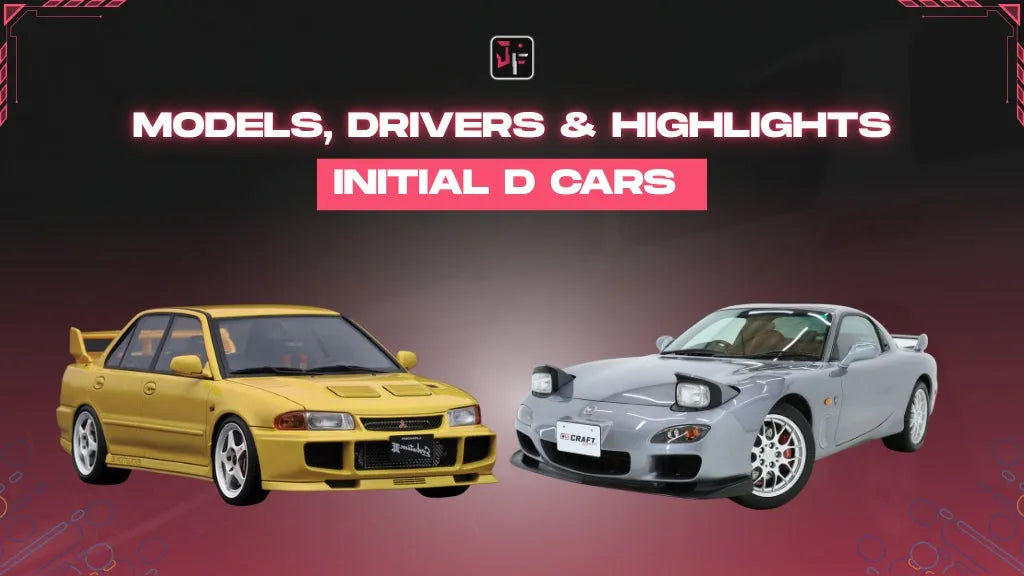
Initial D Cars have captivated fans around the world, showcasing the thrill of Japanese street racing and iconic performance machines like the legendary Toyota AE86. From tight mountain passes to adrenaline-fueled races, these cars are more than vehicles, they are symbols of skill, speed, and culture. Whether you’re a longtime fan or new to the series, exploring the full lineup of all cars in Initial D reveals their unique personalities and racing legacies.
Dive into our guide to discover every Initial D car model, the drivers behind them, and their standout moments. For collectors and enthusiasts, don’t miss out on exclusive Initial D cars merchandise at Japan Figure, bringing these legendary machines to life in your own collection.
When people talk about legendary Japanese street racing, Initial D Cars instantly come to mind. The Initial D series, created by Shuichi Shigeno, is one of Japan’s most influential car-themed franchises, blending high-speed mountain racing with emotional storytelling. Set in the Gunma Prefecture, the story follows Takumi Fujiwara, a seemingly ordinary teenager who becomes an unbeatable racer thanks to his daily tofu delivery runs in his iconic Toyota Sprinter Trueno AE86.

The concept of Initial D revolves around “touge”, mountain pass racing, where skill, precision, and car control matter more than raw horsepower. This realistic portrayal of Japanese car culture made the anime and manga a global sensation, inspiring millions of car enthusiasts to fall in love with drifting, JDM cars, and the artistry of modified vehicles.
Over the years, Initial D expanded beyond manga and anime to include movies, video games, and model car collections, making its cars cultural icons. Each car in Initial D represents a distinct personality and racing philosophy, from the balanced 86 to the powerful RX-7s and turbocharged Evos. Their influence continues today through events, car shows, and collectibles available on sites like Japan Figure, where fans can explore official Initial D model cars and bring a piece of the action home.
The world of Initial D is packed with unforgettable machines, each embodying Japan’s street racing spirit. Every Initial D car model has its own story, tied to a skilled driver, intense battle, and technical highlight.
Below is the Initial D cars list featuring some of the most beloved vehicles, their drivers, and the key highlights that made them famous.
The Toyota Sprinter Trueno AE86, often called the 86 car Initial D, is the best car model kits and the true heart of the series. Driven by protagonist Takumi Fujiwara, this lightweight, rear-wheel-drive coupe proves that skill can defeat raw horsepower. Its 4A-GE engine, perfect balance, and drift-friendly setup make it ideal for Gunma’s twisting mountain roads.

The AE86’s greatest appeal lies in its realism , a car any dedicated driver could own, tune, and master. Its “panda” black-and-white color scheme and tofu shop decals became instantly iconic. Beyond anime, it inspired countless drifters and real-world racing events.
The Subaru Impreza represents power and stability in Initial D. Appearing later in the series, it’s driven by Bunta Fujiwara, Takumi’s father, a legendary driver with unmatched skill. The Impreza symbolizes experience and control, balancing all-wheel drive grip with turbocharged performance.
Its entry into the story marks Takumi’s next level of growth. When Bunta gives Takumi a taste of the Impreza’s handling, fans witness the generational shift between driver philosophies, from agile drifting to efficient precision racing.
Among all cars in Initial D, the Mazda RX-7 Type R FD3S stands out for its elegance and performance. Driven by Keisuke Takahashi, this rotary-powered sports car delivers high revs and smooth cornering. Its lightweight body and near-perfect weight distribution make it a touge weapon in the hands of a skilled racer.

In the story, Keisuke’s RX-7 symbolizes ambition and power, the opposite of Takumi’s humble AE86. Their rivalry showcases the difference between horsepower dominance and precise driving technique. The FD3S also became a fan favorite in real life, inspiring countless tuners to recreate Keisuke’s yellow masterpiece.
The Mazda SAVANNA RX-7 FC3S represents elegance, maturity, and control among Initial D cars. Driven by Ryosuke Takahashi, the elder brother of Keisuke, this white FC3S is more than a machine, it’s a symbol of strategic racing. Ryosuke, known as the “White Comet of Akagi,” uses his RX-7 as an extension of his mind, emphasizing precision over recklessness.
The FC3S’s turbocharged rotary engine delivers smooth yet powerful acceleration, while its balanced chassis makes it a formidable rival on the touge. It’s not just a car but a reflection of Ryosuke’s calm and calculating personality, combining intelligence and mechanical mastery to dominate races.
The Subaru WRX STI Type R plays a crucial role later in the Initial D storyline, showing Takumi’s evolution beyond the AE86. Given by his father, Bunta, this Impreza combines rally-bred power with precision handling. Its symmetrical all-wheel-drive system provides incredible grip even on slippery mountain roads, proving that performance doesn’t rely solely on drifting.

The car marks a turning point for Takumi, as he learns to adapt his instincts to a new kind of power delivery and stability. The Impreza symbolizes progress, bridging the old-school drifting world with modern high-performance tuning.
Among the fiercest Initial D cars, the Mitsubishi Lancer Evolution III stands out for its raw turbo power and aggressive handling. Driven by Kyoichi Sudo, leader of the Emperor team, this AWD machine challenges Takumi’s AE86 in one of the series’ most thrilling rivalries. The Evo III’s balance of traction and acceleration makes it almost unbeatable on straight sections.
However, the Evo’s strength also exposes its weakness, overconfidence in power without the same finesse Takumi masters through drifting. This clash highlights the eternal theme of Initial D: skill versus speed.
The Honda S2000 AP1 is a precision-focused roadster known for its high-revving engine and agile handling. In Initial D, it’s driven by Dr. Toshiya Joshima, nicknamed “God Hand,” showcasing the blend of technical skill and car mastery. The S2000’s naturally aspirated 2.0L F20C engine allows for smooth, responsive driving, making it ideal for tight mountain passes and skilled drifting.

This car emphasizes the importance of driver ability over raw power, reflecting Initial D’s theme that technique can outshine sheer speed. Its balance and precision make it a standout among other JDM machines of the series.
The Nissan Sileighty is a unique blend of Nissan Silvia S13 front end and 180SX rear, driven by Mako Sato with co-pilot Sayuki. Dubbed Impact Blue, this car demonstrates creativity in the tuning scene and excels in tight, technical racing. Its lightweight chassis and rear-wheel-drive setup allow for controlled drifts and agile maneuvers on mountain passes.
The Sileighty’s presence in the series highlights how innovation and customization can make an otherwise standard car competitive against more powerful rivals. Its subtle modifications, like Rays Volk mesh wheels and a B-Wave spoiler, give it both style and performance.
The Mitsubishi Lancer Evolution III GSR is a turbocharged powerhouse that combines all-wheel-drive traction with aggressive acceleration. Driven by Kyoichi Sudo, this Evo III is a symbol of raw power and tactical racing. Its high boost and responsive turbo make it a formidable opponent on both straightaways and hairpin turns.

The car’s rivalry with Takumi’s AE86 emphasizes the series’ central theme: skill versus horsepower. Despite the Evo III’s strength, Takumi’s mastery of drifting proves that experience and technique can overcome sheer engine power.
The Nissan Silvia S13, driven by Koichiro Iketani, is one of the first cars Takumi encounters on Mount Akina. Lightweight and balanced, it serves as a learning platform for Takumi’s early drifting experience. Its rear-wheel-drive design makes it ideal for sliding through tight corners, showing the fundamentals of touge racing.
The S13 also represents the grassroots street racing culture, proving that even moderately powered cars can be competitive with skillful driving. Its clean design and practical tuning options make it a fan favorite for both anime enthusiasts and real-world JDM collectors.
The Initial D series is structured into several stages, each introducing new rivalries, cars, and challenges. Across these stages, fans witness the evolution of both drivers and their vehicles. Below is a breakdown of all cars in Initial D by stage, helping fans and collectors understand the full lineup and their significance.
The First Stage introduces the world of mountain pass racing and sets the foundation for Takumi’s legendary status. Most cars in this stage are lightweight, rear-wheel-drive vehicles, emphasizing skillful drifting over raw power. These cars define the classic touge racing feel: lightweight, agile, and easy to drift, making them perfect for tight mountain roads.
Cars and drivers:

The Second Stage introduces more powerful competitors and marks the rise of Project D’s formation. Turbocharged and AWD vehicles appear here, raising the stakes for Takumi and his AE86. This stage focuses on balancing raw speed with drift skill. Fans see the first serious challenge for Takumi against high-powered AWD machines.
Cars and drivers:
The Third Stage is also released as a movie, showing Takumi facing a series of elite racers. Vehicles here are upgraded versions of classic models with performance tuning. Third Stage raises the series’ intensity by including advanced cars with custom tuning, reinforcing Initial D’s reputation for accurate and exciting car battles.
Cars and drivers:

The Fourth Stage expands on Project D’s journey across the Kanto region, introducing faster cars and newer technologies. This stage emphasizes strategy, teamwork, and skillful navigation of mountain passes. Drivers face more powerful opponents, making Takumi’s AE86 rely heavily on experience and precision to remain competitive.
Cars and drivers:
The Fifth Stage sees Project D tackling high-level rivals and fully exploring the limits of their vehicles. Most cars here have professional-level modifications, turbocharged engines, and race-ready setups. Fifth Stage focuses on refined racing skills, teamwork, and strategic use of each car’s capabilities.
Cars and drivers:

Extra Stage OVAs highlight side stories and one-off races. These episodes focus on individual rivalries and fan-favorite cars outside the main Project D battles. Extra Stage allows fans to enjoy personal rivalries, showing cars in unique scenarios and highlighting their individual characteristics.
Cars and drivers:
Extra Stage 2 continues the trend of special episodes focusing on fan-favorite characters and their vehicles, emphasizing skill and style over raw speed. This stage celebrates the legacy of Initial D cars, showing their continued relevance in new races and maintaining the balance between technique and power.
Cars and drivers:

In summary, Initial D cars are more than just anime vehicles, they are cultural icons that showcase the heart of Japanese street racing, skillful driving, and timeless car designs. Exploring the full Initial D cars list reveals the diversity, history, and excitement behind every stage and race. Whether you’re a collector, racing enthusiast, or anime fan, these cars continue to inspire and thrill.
If you’re new to Initial D or a longtime fan, it’s natural to have questions about the cars, drivers, and their real-life counterparts. Here are some of the most frequently asked questions about Initial D cars, answered concisely to give you the essential information.
The main car in Initial D is the Toyota Sprinter Trueno AE86, driven by Takumi Fujiwara. It’s a lightweight, rear-wheel-drive coupe famous for its agility in mountain pass (touge) racing. Other notable cars include the Mazda RX-7 (FD3S), Mitsubishi Lancer Evolution III, and Subaru Impreza WRX STI.
Yes, the Toyota Celica GT-Four ST205 appears in Initial D, driven by Miki. It’s a high-performance, turbocharged all-wheel-drive sports car that participates in Project D races, showcasing the diversity of Japanese performance cars featured in the series.
The AE86 is a Toyota Sprinter Trueno GT-APEX, produced between 1983 and 1987. It’s a lightweight, rear-wheel-drive coupe known for its balance, drifting ability, and legendary role in Initial D. Its “panda” two-tone paint is iconic among fans and car enthusiasts worldwide.
Initial D features two main RX-7 models: the FC3S (1985–1991) driven by Ryosuke Takahashi, and the FD3S (1991–1995) driven by Keisuke Takahashi. Both cars are rotary-powered Mazdas, highly regarded for their handling, power-to-weight ratio, and drifting performance.
Takumi’s father, Bunta Fujiwara, drives a Subaru Impreza WRX STI Type R in later stages of Initial D. Initially, he was the original owner of Takumi’s AE86. Bunta’s Impreza is fast, agile, and nearly stock, reflecting his skillful, understated driving style.

Soma Higarashi
Soma Higarashi has over five years of experience covering anime, manga, and Japanese pop culture. He is also an active community leader who moderates several large fan groups dedicated to anime and Japanese culture, sharing insights with audiences worldwide.



Share:
Top 10 silver tempest most valuable cards: Best pulls to collect
Top 12+ best Psychic Pokémon cards to collect in 2026